LINC Systems carries a variety of laser coding systems to accommodate your high-speed needs. We offer systems that work for multiple industries, including pharmaceutical, animal pharma, food and beverage, medical, automotive and many others. Depending on the equipment you choose, the lasers can code on a range of surfaces. Substrates include paper, wood, plastic, glass, ceramics, metals, rubber and more.
Laser coding systems are used for coding products and materials and use one of the most cost-effective methods in the coding and marking category. Our laser coding machines are high quality and easy to use. They can reduce costs and improve efficiency on your production line. They are part of our full range of packaging equipment.
We carry industrial laser coding equipment from Markem-Imaje and Squid Ink. These precise systems give your products permanent coding of text, time and date, bar codes and more with quick and easy installation.
A laser coding system is also called a laser marking system, a laser coder or a laser marker. Whatever the name, the job is the same: high-speed marking and coding of dates, lot numbers and barcodes right on the product or package, with no ink.
Get a Laser Coder Quote or call 800.513.9918
How Laser Coding Works
A laser coder does not print. It uses a focused beam of light to change the surface of the package: it removes a thin layer of ink or coating, changes the color of the material, or etches it. The result is a code made from the package itself, so there is nothing to smear, fade or rub off.
Laser marking is a non-contact process. Depending on the substrate, the laser energy works in one of a few ways. It can remove a coating (laser ablation), etch or engrave a shallow mark into the surface, or change the color of the material. On printed cartons, removing the ink gives a high contrast, legible code. That range of laser processing methods is what lets one laser system mark a wide variety of materials.
The beam is steered by two small mirrors inside the marking head, which "write" each character as the product moves past on the line. Because nothing touches the product and there is no drying time, a laser coder can mark products moving at high line speeds, including bottles, cans, pouches and cartons.
Laser coders use no ink, solvent or ribbons. The main running costs are electricity, the fume extraction filter and routine cleaning of the lens. That is why laser coding is one of the lowest cost-per-code methods on a busy line. Because the laser requires no consumables like ink or ribbons, it is a simple coding solution for plants that want fewer supply orders and less downtime.
Types of Laser Coders
The right laser depends on what you are marking. The wavelength decides which materials the laser can mark well. The two types of laser marking used on most packaging and parts lines are CO2 and fiber, and LINC's laser markers cover both.
| Laser type | Best on | Typical uses | From LINC |
|---|---|---|---|
| CO2 laser coder | Paper, cardboard, labels, glass, PET and many plastics, wood, coated materials | Date and lot codes on cartons, bottles, pouches, films and labels | Markem-Imaje SmartLase C350, Squid Ink SQ-LASER (SQ-10 10 W, SQ-30 30 W) |
| Fiber laser coder | Metals, hard plastics such as HDPE and PVC, cables and pipe | Codes and 2D codes on cans, caps, metal parts, extruded products | Markem-Imaje SmartLase F250 |
CO2 Laser Coders
CO2 lasers are the most common laser coders on packaging lines. Their wavelength is absorbed well by paper, cardboard, glass and most packaging plastics. On a printed carton, a CO2 laser removes the ink in the shape of the code, so the brown board shows through as a sharp, permanent mark. The Markem-Imaje SmartLase C350 is a 30-watt CO2 coder that prints up to 2,100 characters per second. Squid Ink's SQ-LASER coders are CO2 lasers too, in a 10-watt (SQ-10) and a 30-watt (SQ-30) model.
Fiber Laser Coders
Fiber lasers use a shorter wavelength that metals and hard plastics absorb well. They are the usual choice for coding aluminum cans, metal parts, caps and many extruded plastics. They also handle the small, dense 2D codes used for traceability. The Markem-Imaje SmartLase F250 is a fiber laser coder built for complex 1D and 2D codes at high speed. On metals, a precise fiber laser can engrave the surface or anneal it, changing its color without removing material.
Choosing the type of laser comes down to your materials and applications. CO2 coders cover the widest range of materials on packaging lines, while fiber coders add precision and durability on metals and hard plastics. Both laser technologies give the versatility to mark text, codes, a logo or a simple graphic.

Markem-Imaje SmartLase Laser Coding System
The SmartLase® F250 fiber laser coder delivers superb code quality in highspeed applications, even with increasing code complexity of 1D and 2D codes, all in an easy-to-integrate and easy-to operate compact unit.


Squid Ink SQ-LASER Coding Systems
Squid Ink's SQ-LASER laser coding systems are designed for high speed food and beverage, pharmaceutical, cosmetic, and other primary coding applications. Squid Ink lasers can permanently mark onto paper, cardboard, plastic, glass, wood, coated metal, leather, and more.

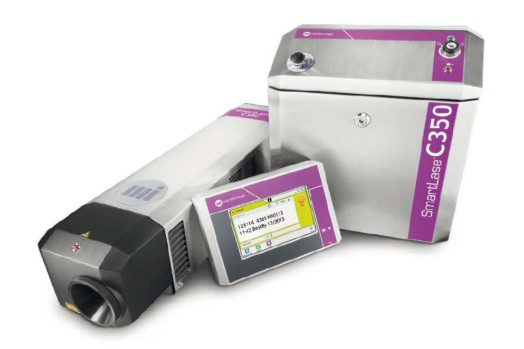
Markem-Imaje SmartLase C350
Designed to deliver permanent, crisp, clear, and traceable codes in high-speed packaging lines, the SmartLase C350 features a wavelength of 10.6 um and can code a range of product surfaces – from pouches to bags to films to bottles and bulbs. Powered by a 30-watt, CO2 laser, it offers print speeds of up to 2,100 characters per second – ideal for applications that require complex codes. Introducing new, patented “SmartLase Code Technology ” embedded into all SmartLase models. This innovative advance includes single and universal fonts as well as algorithms capable of scribing impeccable lines, curves, and points faster than ever before. It delivers 2 key benefits; 30% greater printing performance with best scribing quality compared to market standards, for the beverage industry, output rate increases from 1,200 to 1,800 bottles/min. and for the food industry, character printing capacity of one code increases from 30 to 120 characters, for improved traceability and anti-diversion.
What a Laser Coder Can Print
Laser coding systems print the same kinds of codes as ink-based coders. Most lines use them for:
- Date codes: best by, use by, packed on and production dates. This is the most common job, which is why many plants call these machines laser date coders.
- Lot and batch codes: for recalls and quality tracking.
- Time stamps and shift codes: to trace a product back to a line and a shift.
- Barcodes and 2D codes: including Data Matrix and QR codes for traceability and serialization.
- Text, logos and graphics: fixed text, sequential numbers and simple artwork.
Most of these are product coding jobs that have to stay readable through shipping and storage, such as expiration dates on food and drug packaging. Laser coding and marking gives permanent marking that keeps the code legible for the life of the package.
Laser Coding vs Inkjet and Thermal Transfer Coding
Laser coding is one of several coding and marking methods. Each one fits some lines better than others. Compared with the other coding technologies and marking technologies, lasers are easy to operate once set up, give high-quality codes and keep up with high line throughput.
| Method | How it marks | Consumables | Good fit |
|---|---|---|---|
| Laser coding | Changes or removes the surface | None besides filters | High-speed lines, permanent codes, products that suit laser marking |
| Continuous inkjet (CIJ) | Sprays fast-drying ink | Ink and make-up fluid | Curved, wet or uneven surfaces, almost any material |
| Thermal inkjet (TIJ) | Prints ink from a cartridge | Ink cartridges | Cartons, labels and porous surfaces, high-resolution codes |
| Thermal transfer overprinting (TTO) | Melts ink from a ribbon onto film | Ribbons | Flexible film packaging and labels |
A laser coder usually costs more up front than an inkjet coder, but it has no ink to buy and fewer parts to clean. On high-volume lines, the lower running cost often makes up the difference over the life of the machine, so compare total cost of ownership, not just the purchase price. On products a laser cannot mark well, an inkjet or thermal transfer coder is the better choice. LINC sells several of these. See all our marking and coding systems.
Industries That Use Laser Coding Systems
Food and Beverage
Date and lot codes on bottles, cans, cartons, pouches and film. Laser codes do not use ink, so there is no ink smell or migration near food, and the codes hold up in cold, wet and washdown areas.
Pharmaceutical and Animal Health
Lot numbers, expiry dates and 2D codes on cartons, labels and blister packs. Permanent, high-contrast codes support traceability and serialization rules.
Medical Devices
Permanent marks on medical device packaging and some device parts, where the code must stay readable for the life of the product.
Automotive and Industrial Parts
Part numbers, serial numbers and 2D codes on metal and plastic parts, usually with a fiber laser. Industrial laser marking systems suit these industrial applications because the marks hold up to handling, heat and wear in industrial environments.
Cosmetics and Personal Care
Clean, small codes on bottles, tubes and boxes that do not spoil the look of the package.
How to Choose the Right Laser Coding System
LINC works with packaging plants across diverse industries to match laser machines and other marking solutions to their marking applications. We also supply the automated packaging equipment around them, from Ravizza bagging machines to stretch wrap machines. Date coding is the most common job, but your line may need more.
Answer these questions and send them to us. We will recommend two or three laser coders that fit your line.
- What are you marking? The material and its color or coating decide the laser type. Ask us about testing a sample.
- How fast is the line? Give us products per minute and line speed so we can size the laser power and marking head.
- What goes in the code? The number of lines, characters and any barcode or 2D code affect the speed the coder needs.
- Where will it be mounted? Space on the line, distance to the product and the plant environment (dust, washdown, temperature) affect the setup.
- What has to connect? Tell us about your line controls, label or code data system and any vision system that checks the codes.
Safety and Fume Extraction
Industrial laser coders are powerful lasers. A safe installation keeps the beam enclosed with shields or guarding at the marking point, uses safety interlocks, and trains operators on safe use. Laser marking also creates smoke and fine particles as it removes material, so most installations include a fume extraction unit with filters. Plan for both when you budget for a laser coding system.
Installation, Training and Support
LINC Systems handles more than the sale. We offer turn-key installation and system integration, training for your operators, spare parts, preventive maintenance programs and post-sale support. Learn more about our technical service and installation and parts supply and support.
Get a Laser Coding System Quote
Tell us what you are coding, how fast your line runs and what the code needs to say. We will help you choose a laser coder. Ask us about testing a sample. Call 800.513.9918 or request a quote.
Get a Laser Coder Quote or call 800.513.9918
Laser Coding FAQs
What is a laser coder?
A machine that marks codes on products with a laser beam instead of ink. It prints dates, lot numbers, barcodes and text by changing the surface of the package.
Are laser codes permanent?
Yes. The code is part of the material, so it does not smear, fade or rub off like ink can.
What materials can a laser coding system mark?
It depends on the laser. CO2 coders mark paper, cardboard, glass, wood and most plastics. Fiber coders mark metals and hard plastics.
Does a laser coder need ink?
No. Laser coders use no ink, solvent or ribbons. You replace fume extraction filters and clean the lens as part of routine care.
Is laser coding better than inkjet?
Not always. Laser coding costs less to run and makes permanent codes, but inkjet works on more surfaces. The right choice depends on your product and line.
How much does a laser marking machine cost?
It depends on the laser type, power, marking head and how the coder is integrated into your line. Laser marking machines usually cost more up front than inkjet coders but less to run. Ask us for a quote on the laser coding machine that fits your marking needs.
How does a laser coding system work?
A laser beam, steered by mirrors in the marking head, changes the surface of the product as it moves past. It removes, etches or changes the color of the material to form the code, with no ink and no contact.
What laser marking and coding applications do you cover?
Date and lot codes, barcodes, 2D codes, text and simple graphics, on lines in food and beverage, pharmaceutical, medical, automotive, cosmetics and more. These are laser coding systems designed for high-speed production lines and their marking and coding applications.
Are laser coding systems safe?
Yes, when they are installed correctly. Safe installations enclose the beam with shields or guarding, use safety interlocks, train operators and add fume extraction at the marking point.
Can you test my product before I buy?
Ask us about testing a sample of your product.
Another question? Call 800.513.9918 or contact us.