Case Sealers
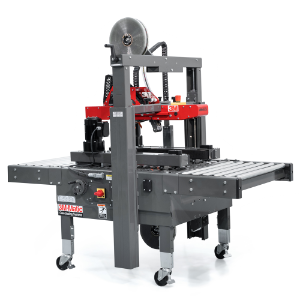
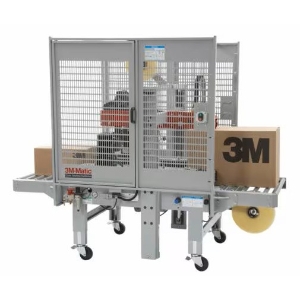
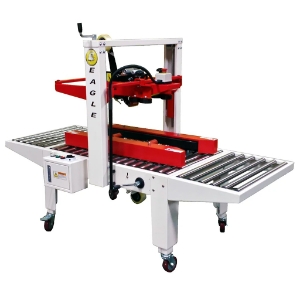
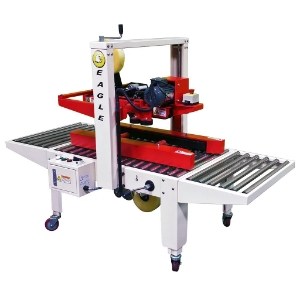
Case Sealers That Seal Every Box Right
A case sealer tapes or glues every carton the same way, so boxes stay closed in transit and your team stops hand-taping or hand-stapling with carton closing staples. LINC carries semi-automatic and fully automatic case sealers from 3M-Matic, Wexxar Bel and Berran Industrial. See the rest of our automated packaging equipment.
You may also hear a case sealer called a carton sealer, a box taping machine or a case taper. They all do the same job: close the flaps on a corrugated box and seal them with tape or hot melt adhesive before the box ships.
What Is a Case Sealer and How Does It Work?
A case sealer is a machine that seals the top and bottom flaps of a filled carton. On a tape case sealer, side belts or bottom belts carry the box through the machine, and the machine applies pressure-sensitive tape as the box moves. Tape heads apply pressure-sensitive tape across the seam, wipe it down over the edges and cut it at the end of the box. A top and bottom case sealer applies top tape and bottom tape in one pass, while a bottom-only model tapes just the bottom.
A hot melt case sealer works the same way, but instead of tape it applies beads of hot melt adhesive to the flaps and presses them closed until the glue sets. In both cases, the result is the same seal on every box, at a steady pace. A carton sealing machine works with a wide range of corrugate boxes, as long as each dimension falls within the machine's limits.
Our Case Sealers
- 3M-Matic 8000a and 8000r: AccuGlide case sealers with three taping heads for 2" tape. The 8000a is adjustable for different box sizes.
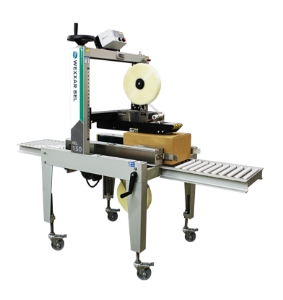
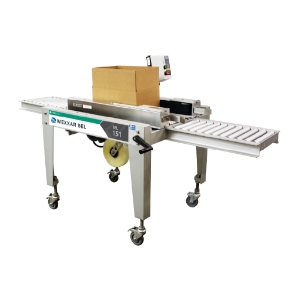
- Wexxar Bel 150 and 151: semi-automatic tape sealers. The 150 tapes top and bottom, and the 151 tapes the bottom.
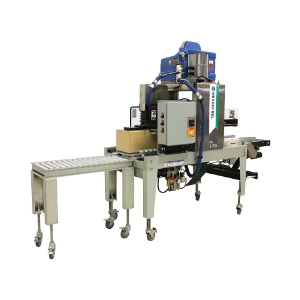
- Wexxar Bel 270: a fully automatic hot melt case sealer.
- Berran Industrial Eagle T100 and T200: semi-automatic case sealers for everyday packing lines.
LINC's site describes the Wexxar Bel BEL 150 as an entry-level top and bottom pressure-sensitive tape case sealer with Uni-Drive squaring technology, a 2 point tool-less case size changeover and speeds up to 30 CPM (cases per minute). It describes the BEL 270 as a fully automatic hot melt case sealer with Snap Folder technology that folds the flaps without flap kickers, at speeds up to 25 CPM. Operating speeds listed for the case sealers on this page range from 15 to 40 boxes per minute, depending on the model.
Types of Case Sealers
Case sealing options fall into a few groups. The right one depends on your application, your boxes and the throughput your line needs.
Semi-Automatic Case Sealers
With a semi-automatic case sealer, an operator closes the top flaps and pushes the box into the machine. The machine then tapes the box automatically. These machines are a simple first step toward automation and fit most packing stations.
Fully Automatic Case Sealers
Fully automatic case sealers fold the top flaps and seal the box on their own, with little or no operator involvement. They suit high speed, continuous lines where boxes arrive on a conveyor. The Wexxar Bel 270 on this page is a fully automatic case sealer. In a fully automatic packaging system, the case sealer usually sits between a case packer and a palletizer or stretch wrapper. LINC's site also lists heavy-duty sealers built for around-the-clock high-speed applications.
Uniform vs. Random Case Sealers
A uniform case sealer is set to one box size at a time. When you change boxes, an operator makes an adjustment to the width and height. Random case sealers adjust to each box automatically, so you can run mixed case sizes on the same line. If you pack one box size all day, a uniform case sealer is usually enough. If your case dimensions change from order to order, look at random case sealers or an adjustable model like the 3M-Matic 8000a.
Tape or Hot Melt?
Tape sealers are simple, affordable and work for most cartons, and for stapled boxes LINC also sells the carton stapler. Hot melt glue sealers form a strong, clean bond and suit high-volume lines and heavier boxes. We carry case sealing hot melt adhesives too.
Whether you choose tape or hot melt adhesive, match the sealing solution to your boxes and your output. Tape sealing is easy to set up and maintain, and it is the most efficient choice for most shops. A hot-melt sealer makes sense when your requirement is a glued seal for heavy or stacked boxes. A tape case sealer runs packaging tape in 2" or 3" widths, depending on the tape head. For boxes you still close by hand, we carry tape dispensers too. Hot melt is common in beverage and food plants and other high-speed lines where boxes are stacked on pallets. LINC's site also lists Shurtape's tape head program, which pairs SP Series tape heads with HP Series carton sealing tapes.
Why Automate Case Sealing?
Machines seal faster and more evenly than hand taping, use tape more efficiently and cut repetitive motion strain for your workers. To print date and lot codes on sealed cases, see our laser coding systems.
LINC's site says case sealers reduce labor, material and the time it takes to seal cases manually, and that many LINC customers have reached a positive ROI in as fast as a year by automating manual case sealing. A case sealer is also the easiest way to partially automate without automating an entire line. It is often the first end-of-line machine a facility adds, ahead of stretch wrapping and strapping, because every shipping and distribution operation seals boxes.
How to Choose a Case Sealer
Which case sealer do you need? Start with these questions:
- Tape or hot melt? Pick the sealing method that fits your boxes and your product.
- One box size or many? One size points to a uniform sealer. Many sizes point to a random or adjustable sealer.
- What are your case dimensions? Check the smallest and largest length, width and height of your boxes against each machine. The sealers on this page list a maximum box width from 18" to 22".
- How many cases per minute? Count your output now and at peak to decide between semi-automatic and fully automatic case sealing. Higher throughput calls for more automation and better line efficiency.
- How will it fit your line? Check floor space, power and whether the case sealer needs to integrate with a conveyor, a case erector or other packaging lines in your facility.
Send us your answers and we'll recommend the case sealing machines that meet your requirements.
Service and Parts
LINC's technical service team installs, maintains and repairs case sealers and other packaging equipment and supplies parts. Learn more about our packaging equipment service.
Regular maintenance keeps a case sealer reliable. Tape heads, blades and belts wear with use, and a worn tape head can leave loose tails or missed seals. LINC offers preventive maintenance and parts supply to keep your sealing equipment running efficiently.
Sustainable Case Sealing
LINC's site lists IPG's 100e paper carton sealing tape, made with a 100% recycled backing, and IPG water activated tape that is recyclable with the carton. See our sustainable packaging options.
Get a Quote
Tell us your box sizes and how many cases you seal a day, and we'll recommend the right sealer. Wrapping or bagging too? See our stretch wrap machines and Ravizza bagging machines. Call 800.252.5894 or contact us.
Case Sealer FAQs
What is the difference between a semi-automatic and a fully automatic case sealer?
With a semi-automatic sealer, a worker folds the flaps and feeds the box. A fully automatic sealer folds and seals the flaps on its own.
Can one case sealer handle different box sizes?
Adjustable sealers like the 3M-Matic 8000a are set for a range of box sizes. Call us with your sizes and we'll find the right fit.
Do you service case sealers?
Yes. Our technicians install, maintain and repair case sealing equipment.
What is a carton sealer?
A carton sealer is another name for a case sealer. It closes and seals the flaps of a box with tape or glue.
What is a sealing machine used for?
A case sealing machine closes filled boxes so they are ready for shipping. It replaces hand taping in warehouse, manufacturing and distribution packaging.
What is the machine that seals plastic bags?
That is a bag sealer, or a bagging machine that forms, fills and seals bags. See our Ravizza bagging machines above.
Which case sealer is best?
The best case sealer is the one that fits your box sizes, sealing method and speed. A semi-automatic tape sealer suits most packing stations, and a fully automatic hot melt sealer suits high-speed lines.
Can I install a case sealer myself?
Some semi-automatic models are simple to set up, but LINC offers installation and training for operators and maintenance staff.